 Posted by
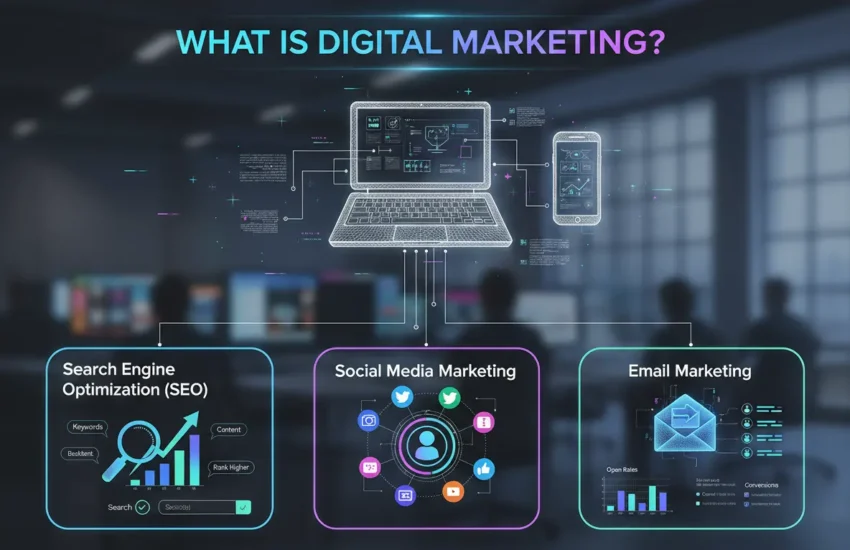
Every company in the modern digital era needs to have a strong online presence in order to remain competitive and relevant. Digital marketing helps businesses to build direct connections with their target audience, build confidence, and expand more quickly than in the past.
compared to traditional marketing, digital marketing enables companies to more affordably access a worldwide audience. Businesses can target specific audiences, monitor performance, and make data-driven choices using channels including social media, search engines, email, and websites.
Additionally, it increases brand awareness because regular online presence makes your company more recognizable and trustworthy to consumers. You may draw in potential clients and turn them into loyal clients by using techniques like SEO, content marketing, and sponsored advertisements.
Importance of Digital Marketing, not just an option. It helps businesses to share information, connect, and grow in a digital space. It is essential to business owners understand what is the importance of digital marketing for business.
What Is Digital Marketing?
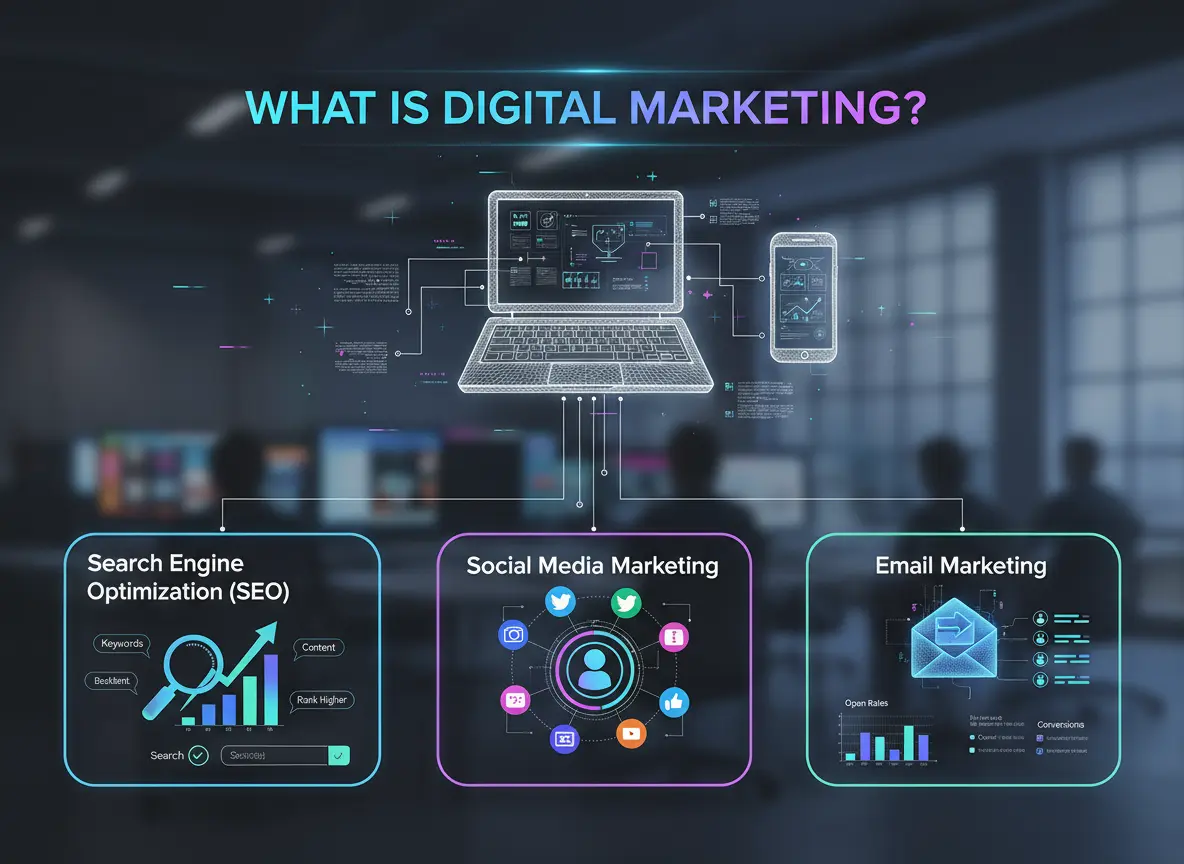
In it simply, digital marketing is the process of advertising goods and services using online channels such as social media, websites, email, and search engines. It promotes cost-effective audience marketing, brand recognition, and sales growth for businesses.
compared to traditional marketing, digital marketing helps businesses to monitor performance, target certain customers, and make quick strategy adjustments. Email campaigns, social media marketing, content marketing, and SEO are examples of common forms.
what is the benefits of digital marketing ?
Digital marketing is growing as one of the most powerful tools for business expansion in today’s internet-driven society. It assists businesses in expanding their audience, increasing brand recognition, and producing revenue while being known and affordable.
Digital marketing offers flexibility, immediate feedback, and effective targeting compared to traditional marketing. Using the appropriate digital tactics may have a significant impact on businesses of all sizes.
The Key Benefits of Digital Marketing:
1-Global Reach:
Without looking at geography, advertise your goods and services to people all over the world.
2-Cost-Effective:
Digital campaigns are perfect for businesses of all sizes because they are more affordable than print or television advertisements.
3-Targeted Audience:
Increase conversion rates by reaching the appropriate audience based on their demographics, interests, and activity.
4-Measurable Results:
You can monitor performance in real time and improve your approach with tools like Google Analytics and Meta Ads.
5-Improved Brand Awareness:
A consistent online presence builds consumer loyalty, trust, and awareness.
6-Better Engagement:
Direct communication with clients is made possible by social media and email marketing, which builds strong relationships.
7-Better Conversion Rates:
Effective digital marketing strategies can convert website visitors into leads and loyal customers.
8-Maintains Your Competitiveness:
Maintaining an active internet presence guarantees that your business stays visible and relevant in the market.
What are the different types of digital marketing?
Marketing has advanced greatly beyond conventional techniques in the current digital era. Businesses can use digital marketing in a variety of methods to reach their target market, advertise their goods, and develop their brand online. Every kind of digital marketing has a specific role to play in increasing awareness, increasing traffic, and boosting sales.
The most important and successful forms of digital marketing that all businesses should be aware of are listed below:
1. Search Engine Optimization (SEO)
The method of making your website more visible on search engines like Google, Bing, and Yahoo is known as search engine optimization, or SEO. The primary objective is to rank higher in search results when people look for business-related keywords, which will help you bring in organic (non-paid) visitors.
Multiple elements make up an effective SEO strategy, such as:
-
- Finding the right keywords that potential customers are looking for is known as keyword research.
-
- Optimizing headlines, titles, meta descriptions, and content to improve your pages’ search engine ranking is known as “on-page SEO.”
-
- Building backlinks from trustworthy sources to boost the authority and credibility of your website is known as off-page SEO.
-
- Technical SEO: Making sure your website is mobile-friendly, loads quickly, and has an easy-to-navigate structure for search engines.
-
- content optimization is the process of producing excellent, helpful, and engaging content that responds to customers’ inquiries and enhances their stay on your website.
SEO is a long-term strategy rather than a one-time event. Over time, it increases the exposure of your website, brings in qualified leads, and builds customers and search engine confidence.
2. Pay-Per-Click Advertising (PPC)
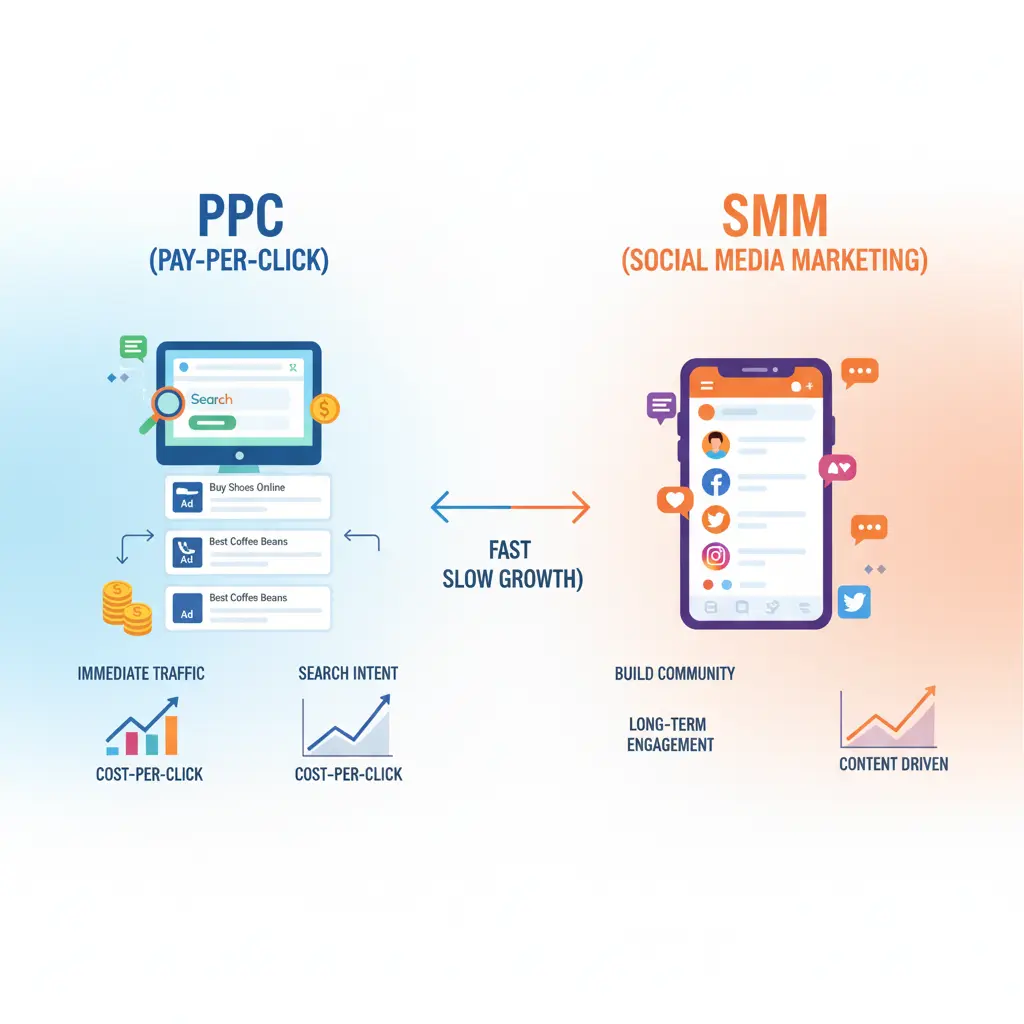
Pay-Per-Click (PPC) advertising is a powerful digital marketing strategy in which businesses pay a fee each time a customer clicks on their web advertisement. PPC is one of the fastest methods to create leads and increase conversions because it allows you to purchase website visits rather than earning them organically.
PPC advertisements can show up on social networking sites like Facebook, Instagram, and LinkedIn in addition to search engines like Google and Bing. Google adverts is the most widely used PPC platform; when users search for keywords that are associated, your advertisements appear at the top of search results.
Key Elements of PPC:
-
- Keyword targeting: Selecting the right keywords guarantees that your advertisements show up for the right searches.
-
- Ad Copy: Writing engaging and effective advertising copy to get clicks.
-
- Creating a clear, action-oriented page that turns visitors into clients is known as landing page optimization.
-
- Setting bids and budgets to manage your click-through rate is known as the bidding strategy.
-
- Performance tracking involves keeping watch on metrics like ROI (Return on Investment), CTR (Click-Through Rate), and CPC (Cost Per Click) in order to improve campaigns.
Benefits of PPC Advertising:
-
- provides immediate results and visibility.
-
- enables effective targeting according to geography, interests, and demographics.
-
- provides comprehensive insights and provable performance.
Because you just pay for actual clicks, it supports budget flexibility. PPC advertising may effectively support your long-term SEO strategy, increase brand visibility, and produce high-quality leads when done correctly.
3. Social Media Marketing (SMM)
The method of using social media platforms to engage with your audience, develop a strong online presence, and promote your business is known as social media marketing, or SMM. Platforms like Instagram, Facebook, LinkedIn, YouTube, and X (Twitter) allow businesses to post content, communicate with followers, and attract new clients.
The importance of social media resides in its ability to enable direct communication between brands and audiences. It helps businesses in developing connections, trust, and community involvement in addition to advertising.
Key Components of Social Media Marketing:
1-Content creation is the process of sharing insightful articles, pictures, videos, and narratives that capture the core values and objectives of your brand.
2-Community engagement is reacting to messages, comments, and feedback in order to build genuine relationships with your audience.
3-Advertising campaigns: Using paid advertisements to reach particular audiences, boost visibility, and improve traffic or conversions.
4-Analytics & Insights: Monitoring performance, reach, and engagement to determine what kinds of content are most effective.
Benefits of Social Media Marketing:
-
- Boosts Brand Awareness: Makes you more visible to new clients.
-
- Improves Customer Relationships: Provides feedback and interaction in real time.
-
- Increases Traffic and Sales: Successfully advertises your website, products, or services.
-
- Cost-effective Promotion: Provides choices for all sizes of businesses, both free and paid.
-
- Develops Trust and Loyalty: A brand’s reputation is strengthened by consistent and sincere interaction.
Posting is just one component of social media marketing; other components include connecting with your audience, telling stories, and adding value. When applied properly, it can make your brand a well-known and reliable name on the internet.
4. Content Marketing
The main goal of content marketing is to engage in and keep an audience by creating and sharing useful, relevant, and consistent content. It concentrates on offering knowledge, answers, and insights that create long-term trust and relationships with potential clients rather than aggressively marketing a product or service.
Businesses may demonstrate their knowledge and provide genuine value to their audience using a variety of content formats, including blogs, videos, infographics, podcasts, case studies, and social media posts. This strategy establishes your brand as a reliable authority inside your industry.
Key Components of Content Marketing:
1- content strategy is the process of defining what kind of content to produce, for whom, and for what purposes.
2- Articles and blog posts: Written content that improves search engine rankings while educating and informing readers.
3- Video Content: Entertaining videos that successfully illustrate products or communicate your narrative.
4- Infographics and Visuals: Present complicated concepts and information in an eye-catching manner.
5- E-books and guides: Provide comprehensive information to develop email lists and nurture leads.
6- Bite-sized, shareable material that increases brand reach and engagement is known as social content.
Benefits of Content Marketing:
-
- Develops Authority: Establishes your business as a reputable authority in your industry.
-
- Increases Organic Traffic: Increases the search engine ranking of your website.
-
- Boosts Customer Engagement: Promotes deep connections with your brand.
-
- Supports Other Marketing Channels: Boosts email marketing, social media, and SEO initiatives.
-
- Produces Leads: Educates prospective clients and directs them toward a purchase.
By bringing in the correct audience, building trust, and eventually increasing revenue, content marketing is a long-term investment that pays dividends. Your brand’s online reputation grows stronger the more value you offer.
5. Email Marketing
One of the most effective and successful types of digital marketing is email marketing. It involves sending personalized and targeted emails to a group of people in order to promote relationships, advertise products, and increase consumer interaction.
Email, compared to many other marketing platforms, provides you with direct access to your audience’s inbox, enabling you to regularly and personally engage with them. Email marketing is still an effective method for increasing sales and keeping customers, whether it is used to share business news, provide discounts, or nurture leads.
Key Components of Email Marketing:
-
- A list of people who have expressed interest in your brand and chosen to receive updates is called a subscriber list.
-
- Customizing communications according to consumer behavior, preferences, or past purchases is known as personalization.
-
- Segmentation is the process of grouping up your audience into smaller groups in order to offer more relevant content.
-
- Automation: The process of sending pre-planned or behavior-triggered emails, like welcome messages or reminders for abandoned carts.
-
- Performance tracking: Monitoring open, click-through, and conversion rates to improve your campaigns.
Benefits of Email Marketing:
-
- Cost-effective: A low-cost approach that generates a good ROI.
-
- Direct Communication: Does not rely on third-party platforms; instead, it speaks with clients directly.
-
- Increases Customer Loyalty: Consistent, insightful communication keeps your brand at the very top of the minds of your customers.
-
- Boosts Conversions: Promotes ongoing business and increases website traffic.
-
- Encourages Retargeting: Assists in re-engaging former visitors or inactive clients.
Because it can provide results—nurturing leads, sustaining connections, and converting prospects into devoted customers—email marketing is still a key component of digital strategy.
6. Affiliate Marketing
Affiliate marketing is a performance-based digital marketing approach in which corporations collaborate with people or other businesses (referred to as affiliates) to market their products or services. Affiliates earn a commission for each sale, lead, or action brought about by their special referral links.
Both parties profit from this strategy: affiliates get money by promoting products they believe in and trust, while businesses increase exposure and sales without spending significant investments.
How Affiliate Marketing Works:
-
- Creating a Partnership: The business (merchant) collaborates with influencers or affiliates who have a product-relevant audience.
-
- Affiliates use blogs, websites, YouTube channels, and social media platforms to promote the product.
-
- Tracking: To keep monitor on the traffic and purchases brought about by their promotions, each affiliate receives a special tracking link.
-
- Commission Payment: For each lead or sale that is successful, the affiliate receives a commission.
Benefits of Affiliate Marketing:
-
- Cost-effective: There is no unnecessary advertising expenditure; you just pay for outcomes.
-
- Increases Reach: Makes use of affiliates’ audience and influence to bring in new clients.
-
- Establishes Credibility: Products recommended by reliable affiliates are immediately trusted by followers.
-
- Increases SEO and Traffic: High-quality backlinks from affiliate websites increase exposure and organic reach.
-
- Scalable: For broader coverage, you can have several affiliates promote your business simultaneously.
Through collaboration and confidence, affiliate marketing is a great way for brands to expand quickly. It helps your business to effectively enter new markets by turning your partners and audience into an active sales team.
7. Influencer Marketing
Influencers are people who have a large following and credibility in a certain field. Influencer marketing is a contemporary and very successful digital marketing method. These influencers use relatable and genuine content to market your business, item, or service to their audience.
Influencer marketing is effective because customers are more likely to believe suggestions from genuine individuals than from conventional advertisements. Influencers promote businesses in increasing customer awareness, trust, and engagement through social media postings, videos, and product evaluations.
Key Components of Influencer Marketing:
-
- Selecting the Correct Influencers: Pick influencers whose audience is similar to the target demographic for your brand.
-
- Collaboration Strategy: Choose between sponsored posts, product reviews, giveaways, or brand ambassadorships.
-
- Content Creation: Give influencers the freedom to produce authentic, imaginative Content that highlights your business and connects with their audience.
-
- Performance measurement: Monitor conversions, reach, and engagement rates to assess the effectiveness of a campaign.
Benefits of Influencer Marketing:
-
- Develops Trust Fast: Influencers already have an engaged following who value their viewpoints.
-
- Boosts Brand Awareness: Introduces your business to fresh, relevant customers.
-
- Increases Engagement: By using genuine narrative, it increases likes, comments, and shares.
-
- Increases Sales: Higher conversion rates are frequently the result of personal referrals.
-
- Improves Brand Image: Your brand’s reputation is strengthened when you collaborate with respectable influencers.
The power of social evidence and storytelling are combined in influencer marketing. When done correctly, it not only raises awareness of your business but also creates long-lasting connections with your audience by being genuine and trustworthy. All of these forms of digital marketing are important for businesses.
What is the Future of Digital Marketing ?
The field of digital marketing is changing more quickly than in the past. Businesses need to keep ahead of trends to be competitive in the face of ongoing technology developments, changing consumer behavior, and the daily emergence of new internet platforms.
The future of digital marketing is about being intelligent, individualized, and focused on people, not just about being online. To establish stronger bonds with their customers, marketers will depend more on data-driven choices, automation, and immersive experiences.
1. Automation and artificial intelligence (AI)
AI is changing ways businesses interact with their clientele. Marketing automation solutions, such as chatbots driven by AI and predictive analytics, are improving the effectiveness and customization of campaigns.
-
- Chatbots enhance user experience and provides continuous customer service.
-
- Trends and customer behavior can be predicted with the use of predictive analytics.
-
- AI tools speed up data analysis, which facilitates real-time campaign optimization.
AI will eventually take care of more boring jobs, freeing up marketers to work on strategy and creativity.
2. Voice Search Optimization
Voice search is becoming an essential part of SEO due to the growing use of smart speakers and voice assistants like Alexa, Siri, and Google Assistant.
In order to adjust, marketers must:
-
- Content should be optimized for conversational keywords.
For “near me” searches, focusing on local SEO.
-
- Provide content in the form of FAQs that addresses particular voice inquiries.
Digital marketing will become more natural, engaging, and user-focused with voice search.
3. Video and Interactive Content
Online interaction is still dominated by video, and its importance will only increase. Visual storytelling promotes greater emotional connections, as seen by platforms like YouTube, Instagram Reels, and TikTok.
Polls, tests, live broadcasts, and virtual reality filters are examples of interactive content that increases user engagement and makes marketing more memorable. By utilizing these forms, brands may increase trust and engagement.
4. Customization and Client Experience
Personalized marketing will become usual in the future. Customers believe that brands will be aware of their interests, habits, and preferences.
Businesses can provide highly specific content using data analytics, ranging from dynamic website experiences to personalized emails and product suggestions.
This change will result in a marketing environment that emphasizes developing relationships rather than just selling.
7. Virtual reality (VR) and augmented reality (AR)
Customers’ online product experiences are changing as a result of AR and VR. Before making a purchase, customers can use these technologies to see products in actual environments.
For instance:
-
- AR apps allow users to visually “try on” furniture, makeup, or clothes.
-
- Virtual tours of shops or locations are made possible via VR experiences.
These tools will improve the customer experience and decrease buy hesitancy as they become more widely available, especially for e-commerce.
Digital marketing will be dynamic, data-driven, and fundamentally human in the future. Marketers must embrace innovation as technology develops while remaining genuine and customer-focused.
Businesses that embrace the latest developments like artificial intelligence (AI), customization, ethical marketing, and immersive experiences will not only endure but thrive in the digital age. The ability of digital marketing to create intelligent, interesting, and value-driven relationships with people—rather than just boosting ad numbers—is what makes it so important for businesses.
The future of digital marketing is about building intelligent, engaging, and value-driven relationships with people, not about increasing the number of advertisements.
Freelance Digital Marketing: Collaborate with the Right Expert
Working with a freelance digital marketer can be a wise choice if you’re a business owner trying to increase your online visibility. Freelancers frequently offer affordable, adaptable, and highly customized services compared to big agencies. They can serve as a committed extension of your team, customized to your objectives and financial constraints.
Who Is the Best Freelancer in Digital Marketing?
A top-tier freelancer in digital marketing usually has a solid portfolio of accomplishments from a variety of channels (SEO, social media, PPC, content). They understand your target market, establish specific KPIs, provide tangible outcomes, and sustain open lines of communication. When a business caters to a local market, local knowledge (such as in Malappuram) is an advantage.
I work as a freelancer in the Malappuram district and specialize in digital marketing. I highlight my expertise in search engine optimization (SEO), content marketing, social media strategy, paid advertising, and lead generation campaigns created specifically for local and online businesses on my website, www.marketerjasim.site. I work directly with each client to comprehend their specific objectives, develop methods that support them, and produce quantifiable increases in traffic, engagement, and conversions. I can help you succeed whether you’re a Malappuram startup or a company trying to grow online by offering my knowledge of the local market and my proficiency with digital marketing.
In today’s online world, digital marketing is essential for business expansion. Through SEO, social media, and innovative tactics, it assists brands in reaching the appropriate audience, developing trust, and achieving quantifiable outcomes.
AI, personalization, and innovation will be key components of marketing in the future as technology advances. Adaptable businesses will prosper.
Are you trying to find the best freelance digital marketer in malappuram? Get in touch with Quikly to improve your business.